
What Energy Efficiency Trends Are Transforming Homes and Offices?
The Key Importance of Energy Efficiency
Energy efficiency has moved from being a niche sustainability topic to a central pillar of corporate strategy, public policy, and household decision-making across the United States and other advanced economies. For the information hungry demographic that is visiting here, who track recent developments in the economy, regulation, technology, and lifestyle, energy efficiency is no longer simply about cutting utility bills; it is increasingly about competitiveness, resilience, regulatory compliance, and brand reputation in a world where energy markets, climate policy, and consumer expectations are all evolving at unprecedented speed.
In the United States, the convergence of federal incentives, state-level building codes, and private sector innovation has accelerated the adoption of efficient technologies in both residential and commercial spaces. Programs inspired by the work of the U.S. Department of Energy and the Environmental Protection Agency have encouraged extensive retrofitting of existing buildings and have driven higher standards for new construction, while the private sector has responded with an explosion of smart devices, advanced materials, and integrated energy management platforms. Readers following the broader economy and policy landscape understand that this transformation is tightly linked to macroeconomic stability, industrial strategy, and the United States' position in global markets.
At the same time, international developments-from the European Union's tightening building performance standards to Asia's rapid urbanization-are reshaping global supply chains for efficient equipment and building technologies. Organizations such as the International Energy Agency highlight that energy efficiency remains one of the most cost-effective tools for achieving net-zero emissions while enhancing energy security, as detailed in their global efficiency reports at iea.org. In this context, energy efficiency trends in homes and offices are not isolated technical issues; they are integral to the economic, regulatory, and technological narratives that usa-update covers for its ever-growing and interactively engaged audience in North America and beyond.
Policy, Regulation, and Market Signals Driving Change
Energy efficiency is being driven as much by policy and regulation as by consumer preference and technological progress. In the United States, evolving building codes, appliance standards, and financial incentives have created a strong market signal that shapes investment decisions in both residential and commercial real estate. The U.S. Department of Energy continues to tighten minimum efficiency standards for appliances and HVAC systems, while the EPA's ENERGY STAR program, accessible at energystar.gov, has become a widely recognized benchmark that influences purchasing decisions from refrigerators to office computers.
State and local governments, particularly in regions such as California, New York, and parts of the Pacific Northwest, have introduced building performance standards that require large commercial buildings to meet specific energy intensity targets or face penalties. These regulations are pushing building owners to invest in advanced controls, insulation upgrades, and high-efficiency equipment, turning efficiency from a discretionary expense into a compliance necessity. For businesses tracking regulatory shifts, the evolving landscape is as important as technology itself, and subscribing members or public readers can follow these new trends in more depth through regulation and policy coverage on USA Update.
Globally, policies are similarly tightening. The European Commission has implemented revisions to the Energy Performance of Buildings Directive, mandating higher standards for new buildings and deep renovations across the European Union, details of which are available at ec.europa.eu. In Asia, countries like Japan and South Korea are expanding building labeling schemes and efficiency incentives, while Singapore has positioned itself as a regional leader in green buildings through its Building and Construction Authority initiatives at bca.gov.sg. These developments influence technology diffusion and investment flows that ultimately affect what products appear in American homes and offices and at what price.
Financial markets are reinforcing these policy signals. Large institutional investors increasingly integrate energy performance metrics into their real estate portfolios, and organizations such as the Global Real Estate Sustainability Benchmark (GRESB) at gresb.com have made energy data a core component of asset evaluation. This trend links efficiency performance directly to access to capital and cost of financing, particularly for commercial properties. As usa-update.com continues to expand its always unique business and finance reporting, the connection between energy performance, asset valuation, and investor expectations has become a critical dimension for executives and property owners to understand.
Smart Buildings and the Internet of Things in Everyday Spaces
One of the most visible trends transforming homes and offices is the proliferation of smart building technologies, powered by the Internet of Things (IoT). In 2026, connected thermostats, occupancy sensors, smart lighting, and integrated building management systems are increasingly standard in new commercial developments and are rapidly penetrating the residential market as well. Major technology companies, including Google, Amazon, and Apple, have invested heavily in smart home ecosystems, enabling homeowners to control energy use via mobile apps, voice assistants, and automated routines. For example, readers can explore how smart thermostats optimize heating and cooling schedules at energy.gov to understand the data-driven logic behind these devices.
In commercial settings, advanced building management systems integrate HVAC, lighting, security, and sometimes even on-site generation into a single platform, using data analytics and machine learning to adjust operations in real time. Companies such as Siemens, Johnson Controls, and Honeywell have expanded their digital building solutions, offering cloud-based platforms that monitor energy consumption across portfolios of buildings, identify anomalies, and suggest or automatically implement corrective actions. These systems are particularly relevant for multi-site enterprises-such as retail chains or office networks-where centralized control can yield substantial savings and greater operational consistency.
The rise of smart technologies is not limited to large corporations or high-end homes. Affordable smart plugs, connected LED bulbs, and Wi-Fi-enabled appliances have opened the door for mainstream households and small businesses to participate in the efficiency revolution. Utility-sponsored demand response programs, some coordinated through platforms like Virtual Power Plants operated by firms such as Tesla and Enel X, allow customers to receive financial incentives for allowing automated adjustments to their devices during peak demand periods. Information on such grid-interactive efficiency strategies can be found through organizations like the Rocky Mountain Institute at rmi.org, which has long advocated for integrated energy solutions.
For the keen followers of USA update, into impartial news around technology and innovation developments, the key takeaway is that smart building technologies are no longer experimental or confined to flagship projects. They are becoming embedded in everyday infrastructure, changing how energy is consumed, managed, and valued in both homes and offices. This shift creates opportunities for technology providers, installers, data analysts, and service companies, while also raising new questions about cybersecurity, data privacy, and interoperability that business leaders must address proactively.
High-Performance Building Envelopes and Materials
While smart devices capture much of the public's attention, the fundamentals of energy efficiency still rest heavily on the physical performance of building envelopes. Insulation, windows, air sealing, and materials selection remain critical determinants of heating and cooling loads, which in many climates represent the majority of building energy use. In 2026, advances in materials science and construction techniques are enabling homes and offices to achieve higher performance levels with lower lifecycle costs than in previous decades.
High-performance windows, including triple glazing, low-emissivity coatings, and insulated frames, are now more widely available and increasingly cost-competitive. Manufacturers across North America and Europe have invested in production capacity to meet growing demand, driven in part by stricter building codes and voluntary programs like Passive House standards, which are detailed at passivehouse.com. These windows reduce heat loss in winter and unwanted heat gain in summer, contributing to both comfort and energy savings, and they are particularly attractive for office buildings with large glazed façades.
Insulation technologies have also evolved, with materials such as advanced foams, mineral wool, and cellulose being deployed in more sophisticated assemblies that reduce thermal bridging and improve airtightness. The American Society of Heating, Refrigerating and Air-Conditioning Engineers (ASHRAE), whose standards are available at ashrae.org, continues to refine guidance on thermal performance and ventilation requirements, providing a technical foundation for architects, engineers, and contractors. For property owners and developers, investing in a high-quality envelope often delivers durable savings that complement more visible technologies like rooftop solar or smart controls.
In addition to traditional efficiency benefits, new materials are being evaluated for their embodied carbon and overall environmental footprint. Organizations such as the U.S. Green Building Council, which administers the LEED certification program and provides resources at usgbc.org, emphasize not only operational energy performance but also the sourcing and lifecycle impacts of construction materials. This holistic perspective resonates with corporate sustainability strategies and ESG reporting frameworks, which increasingly require detailed disclosures on building-related emissions. Business leaders monitoring sustainability and corporate responsibility news recognize that high-performance envelopes are both an energy strategy and a reputational asset.
Electrification and the Future of Heating and Cooling
Another defining trend reshaping energy use in homes and offices is the electrification of heating and cooling systems. In 2026, high-efficiency electric heat pumps are rapidly displacing traditional gas furnaces, oil boilers, and resistance heating in many markets, driven by improvements in cold-climate performance, supportive policies, and the broader decarbonization of electricity grids. The International Energy Agency and the U.S. Energy Information Administration, which publishes data and analysis at eia.gov, have documented the sharp rise in heat pump sales across North America, Europe, and parts of Asia.
Modern air-source and ground-source heat pumps can deliver multiple units of heat energy for every unit of electricity consumed, making them significantly more efficient than combustion-based systems. In commercial buildings, variable refrigerant flow (VRF) systems and large-scale heat pumps are being integrated into sophisticated HVAC designs that also incorporate heat recovery and advanced ventilation controls. These solutions are particularly relevant for office towers, hotels, and mixed-use developments in dense urban environments, where local air quality regulations and carbon reduction targets are tightening.
Electrification is closely tied to the evolving mix of grid electricity. As the share of renewables such as wind and solar grows-supported by policies and investments tracked by organizations like BloombergNEF at about.bnef.com-electrified heating and cooling systems become an increasingly effective pathway for reducing greenhouse gas emissions. For businesses planning long-term real estate strategies, aligning building systems with a cleaner grid offers both cost stability and regulatory risk mitigation, especially as carbon pricing and emissions reporting frameworks expand in jurisdictions worldwide.
For inspired and positive minded visitors of usa-update.com, who follow developments in energy markets and infrastructure, the electrification of buildings intersects with broader debates about grid reliability, transmission expansion, and the role of distributed energy resources. Heat pumps, electric water heaters, and even electric vehicle chargers can all serve as flexible loads that help balance the grid, provided they are equipped with smart controls and integrated into utility and market programs. This integration reinforces the trend toward buildings that are not merely energy consumers but active participants in the energy system.
Distributed Energy, Storage, and Grid-Interactive Buildings
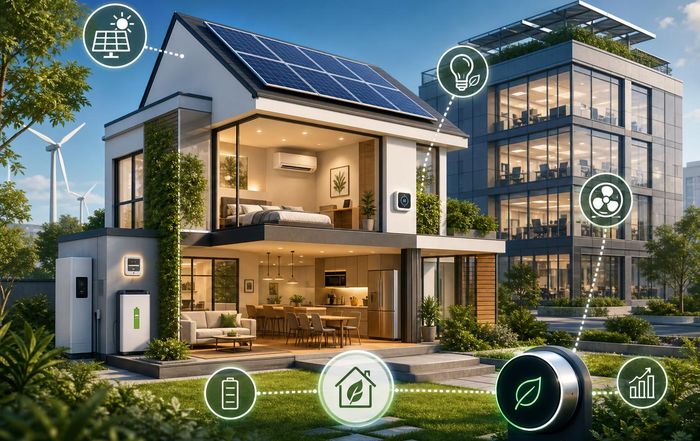
Energy efficiency in 2026 is increasingly intertwined with on-site generation and storage, creating a new paradigm in which homes and offices operate as grid-interactive efficient buildings. Rooftop solar photovoltaics, community solar projects, and behind-the-meter battery systems are becoming common components of both residential and commercial properties, particularly in sun-rich regions of the United States, Europe, and Australia. Organizations such as the Solar Energy Industries Association, which provides market data and policy updates at seia.org, highlight the rapid growth of distributed solar capacity and its integration with building energy systems.
When combined with efficiency measures and smart controls, on-site generation allows buildings to reduce peak demand, hedge against utility rate increases, and maintain critical operations during grid outages. In commercial settings, facility managers are deploying energy management platforms that coordinate HVAC, lighting, and storage to respond dynamically to time-of-use pricing or demand charges, thereby optimizing both cost and carbon performance. This capability is particularly valuable in energy-intensive sectors such as data centers, manufacturing, and large office campuses.
Battery storage, once considered a niche technology, has benefited from significant cost declines and technology improvements, many of which are documented by research institutions such as the National Renewable Energy Laboratory at nrel.gov. Residential batteries, often paired with rooftop solar, enable homeowners to store excess generation for use in the evening or during outages, enhancing resilience in regions prone to extreme weather events. For businesses, larger-scale storage systems can support critical loads, participate in ancillary service markets, and complement microgrid strategies, especially in campuses, industrial parks, and remote locations.
This grid-interactive paradigm is closely aligned with emerging regulatory frameworks that recognize and reward flexible demand. Utility commissions in states like California, New York, and Massachusetts are exploring or implementing tariffs and programs that compensate buildings for providing grid services, turning efficiency and flexibility into revenue-generating assets. As usa-update.com continues to cover energy and consumer trends, the financial and strategic implications of these developments are becoming increasingly relevant for both homeowners and corporate decision-makers.
Energy Efficiency Trends Transforming Homes & Offices
Explore the 2026 shift from basic utility savings to smarter, healthier, grid-aware buildings.
IoT thermostats, sensors, lighting and analytics optimize energy use in real time.
Insulation, triple glazing, air sealing and efficient materials cut heating and cooling loads.
Heat pumps, VRF systems and electric water heating align buildings with cleaner grids.
Solar, batteries and flexible loads turn buildings into active energy assets.
Start with bills, equipment age, comfort issues and building performance data.
Prioritize insulation, windows and airtightness before oversizing new systems.
Use sensors, scheduling, demand response and AI analytics to reduce waste.
Pair heat pumps, solar, storage and flexible loads for resilience and lower emissions.
Relative strategic impact across the efficiency transition:
Estimate simple annual savings from efficiency upgrades.
Estimated yearly savings
Estimated 10-year savings
Choose your starting point:
Data, Analytics, and the Role of Artificial Intelligence
Beyond hardware, the digitalization of energy use is transforming how homes and offices are designed, operated, and maintained. Today data analytics and artificial intelligence (AI) are central to unlocking the full potential of energy efficiency, enabling continuous optimization and predictive maintenance that were not feasible with traditional manual approaches. Building management systems now collect vast quantities of data from sensors, meters, and connected devices, which can be analyzed to identify inefficiencies, equipment faults, and behavioral patterns that drive energy waste.
Technology providers and startups are leveraging machine learning algorithms to create "digital twins" of buildings-virtual models that simulate energy performance under different conditions and operational strategies. These digital twins allow facility managers to test adjustments in software before applying them in the real world, reducing risk and enhancing performance. Research organizations and universities, including leading engineering programs at institutions like MIT and Stanford University, whose work can be explored at mit.edu and stanford.edu, are advancing the underlying science of building analytics and control theory.
AI-driven tools are also entering the residential market in more subtle ways. Smart thermostats learn occupants' schedules and preferences, adjusting temperatures automatically to balance comfort and efficiency. Intelligent lighting systems detect occupancy and daylight levels, dimming or switching off when not needed. Even major appliance manufacturers such as LG, Samsung, and Whirlpool are embedding connectivity and optimization features into refrigerators, washing machines, and dishwashers, enabling them to operate during off-peak hours or respond to utility signals.
For business leaders and professionals tracking technology and employment trends, the rise of data-driven energy management has significant workforce implications. New roles are emerging at the intersection of facilities management, data science, and cybersecurity, while traditional roles are being reshaped by the need to interpret and act on complex performance data. Organizations that invest in training and upskilling their staff to work effectively with these tools are better positioned to capture the full value of efficiency investments and to demonstrate expertise and trustworthiness in their sustainability reporting.
Human-Centric Design, Health, and Productivity
Energy efficiency strategies are increasingly being evaluated not only for their impact on energy bills and emissions but also for their effects on occupant health, comfort, and productivity. In 2026, there is growing recognition that high-performance homes and offices must be human-centric, providing good indoor air quality, appropriate thermal comfort, and access to natural light, while also minimizing energy use. This perspective is supported by organizations such as the World Green Building Council, which publishes research on health and wellbeing in buildings at worldgbc.org.
In office environments, energy-efficient lighting systems that incorporate tunable white LED technology can mimic natural daylight patterns, supporting circadian rhythms and potentially improving employee wellbeing and performance. Advanced HVAC systems with demand-controlled ventilation adjust fresh air supply based on occupancy and indoor air quality sensors, improving comfort while avoiding unnecessary energy use. These features have gained particular attention in the wake of global health concerns, as building owners seek to reassure occupants about the safety and quality of indoor environments.
Residential buildings are also benefiting from this integration of efficiency and health. High-performance envelopes and ventilation systems, including heat recovery ventilators (HRVs) and energy recovery ventilators (ERVs), provide consistent fresh air while minimizing energy losses, which is especially important in airtight, well-insulated homes. Resources from organizations such as the American Lung Association, accessible at lung.org, emphasize the importance of indoor air quality in preventing respiratory issues, reinforcing the value of well-designed ventilation systems.
For readers of usa-update.com, who are interested not only in business and economic trends but also in lifestyle and wellbeing, the convergence of energy efficiency and health represents a significant shift in how buildings are valued and marketed. Employers increasingly view high-quality, efficient office spaces as tools for talent attraction and retention, while homebuyers and tenants are asking more questions about energy performance, comfort, and air quality. Companies that can demonstrate expertise in delivering both efficiency and occupant wellbeing are likely to gain a competitive advantage in real estate and related services.
Regional Perspectives: United States, North America, and Beyond
Energy efficiency trends manifest differently across regions, reflecting variations in climate, building stock, policy frameworks, and market maturity. In the United States, a diverse landscape of state-level policies and utility programs has created pockets of leadership and areas where significant potential remains untapped. States like California, New York, and Massachusetts have aggressive efficiency targets and robust incentive programs, while other regions are only beginning to modernize building codes and utility regulations. The American Council for an Energy-Efficient Economy (ACEEE), which provides state scorecards and policy analysis at aceee.org, offers detailed insights into these regional differences.
In Canada, a colder climate and high heating demands have driven strong interest in high-performance envelopes and heat pumps, particularly in provinces such as British Columbia and Quebec. National programs and building codes emphasize thermal performance and resilience, making Canadian experience particularly relevant for northern U.S. states. Across the broader North American region, cross-border collaboration and technology transfer are shaping product standards and market expectations, influencing how manufacturers and service providers operate.
Europe remains a global leader in building efficiency, with countries like Germany, Denmark, and Sweden pushing the boundaries of low-energy and nearly zero-energy buildings. The European Union's regulatory framework, combined with high energy prices and strong public support for climate action, has driven widespread adoption of advanced windows, insulation, and heat pumps. Case studies from European cities, available through organizations like C40 Cities at c40.org, provide valuable lessons for North American municipalities seeking to upgrade their building stock and reduce emissions.
In Asia, rapid urbanization and rising incomes are driving massive construction of residential and commercial buildings, particularly in China, India, and Southeast Asian nations such as Thailand and Malaysia. While efficiency standards are improving, the sheer scale of new construction presents both challenges and opportunities. International cooperation, technology transfer, and capacity building-often coordinated through entities like the World Bank at worldbank.org-are critical to ensuring that new urban developments incorporate efficient design and technologies from the outset.
For the global audience of usa-update.com, which follows international developments and cross-border business trends, understanding these regional dynamics is essential. Companies operating across multiple markets must navigate differing codes and incentives, while investors must assess regional risks and opportunities associated with efficiency policies and energy price trajectories. At the same time, best practices and innovations developed in one region can often be adapted and applied elsewhere, accelerating global progress toward more efficient homes and offices.
Economic and Workforce Implications of the Efficiency Transition
The transformation of homes and offices through energy efficiency has significant economic and employment implications that are particularly relevant for readers tracking jobs and employment trends on usa-update.com. Efficiency investments create demand for a wide range of skilled professions, including architects, engineers, energy auditors, HVAC technicians, electricians, data scientists, and construction workers trained in advanced building techniques. As governments and private sector organizations ramp up retrofitting and new construction to meet policy goals and market expectations, the need for a trained workforce becomes a central concern.
Studies from organizations such as the International Labour Organization and national labor agencies suggest that the energy transition, including efficiency, can be a net job creator, particularly in local service sectors that cannot be easily offshored. Training and certification programs, often supported by community colleges, trade associations, and unions, are expanding to equip workers with the skills needed to install heat pumps, commission building management systems, and conduct energy modeling. The U.S. Department of Labor, whose resources are available at dol.gov, plays a role in coordinating workforce development initiatives linked to the clean energy economy.
However, the transition also brings challenges. Traditional roles in fossil fuel-based heating, for example, may decline over time, requiring reskilling and support for affected workers and communities. Businesses that rely on outdated technologies may face competitive pressures as clients and regulators demand higher performance and lower emissions. For executives and policymakers, managing this transition responsibly involves not only promoting efficiency technologies but also investing in education, training, and social support mechanisms.
From an economic perspective, energy efficiency can improve national competitiveness by reducing energy intensity and exposure to volatile fuel prices. For households, lower energy bills free up income for other expenditures, potentially stimulating local economies. For businesses, reduced operating costs can improve margins and enable reinvestment in growth and innovation. Financial institutions are increasingly recognizing these benefits, incorporating efficiency considerations into lending criteria, green bonds, and sustainability-linked loans, as highlighted by organizations like the Climate Bonds Initiative at climatebonds.net.
Consumer Behavior, Awareness, and the Role of Media
Despite technological advances and supportive policies, the success of energy efficiency initiatives ultimately depends on consumer awareness and behavior. In 2026, information platforms, including specialized outlets like usa-update.com, play a crucial role in translating complex technical and regulatory developments into accessible insights for homeowners, tenants, business leaders, and investors. Clear communication about the benefits, costs, and practical steps associated with efficiency upgrades is essential to overcoming inertia and misconceptions.
Consumer decision-making is influenced by a range of factors, including upfront costs, perceived comfort and convenience, trust in contractors and vendors, and understanding of long-term savings. Transparency tools such as energy labels, building performance certificates, and online calculators-many of which are supported by government agencies and non-profit organizations-help demystify efficiency investments. For example, the U.S. Department of Energy offers resources to help consumers compare appliance efficiency and estimate savings, while non-profit organizations provide guidance on home retrofits and financing options.
Media coverage that integrates energy efficiency into broader narratives about economic resilience, housing affordability, and lifestyle trends can make the topic more relatable and actionable. On usa-update.com, efficiency intersects with finance when discussing mortgage products that reward efficient homes, with travel when highlighting efficient hotels and transportation, and with entertainment and events when profiling conferences, expos, and cultural initiatives focused on sustainability. By presenting efficiency as a practical, modern, and aspirational choice rather than a sacrifice, media platforms can help shift social norms and consumer expectations.
Trustworthiness and expertise are critical in this communication. Readers expect accurate, up-to-date information that reflects current technology, policy, and market conditions. As the energy landscape evolves rapidly, with new products, standards, and incentives emerging regularly, platforms that can synthesize and contextualize this information provide significant value to their audiences. In this sense, usa-update.com is not only reporting on energy efficiency trends but actively shaping how businesses and households perceive and respond to them, hopefully in a positive inspired way.
Outlook: Strategic Priorities for Businesses and Households
Energy efficiency will remain a cornerstone of the global response to climate change, economic uncertainty, and evolving consumer expectations. For businesses, especially those with substantial real estate portfolios or energy-intensive operations, efficiency is no longer an optional add-on but a strategic imperative that affects cost structure, regulatory risk, and brand positioning. Executives should prioritize comprehensive energy audits, long-term retrofit plans, integration of smart technologies, and alignment with emerging standards and disclosure requirements. Partnering with reputable service providers and leveraging resources from organizations such as the U.S. Green Building Council, ASHRAE, and the International Energy Agency can provide a solid foundation for informed decision-making.
For households, the path forward involves a combination of incremental improvements and strategic upgrades timed with major life events such as home purchases, renovations, or equipment replacement. Replacing aging HVAC systems with high-efficiency heat pumps, upgrading insulation and windows, and adopting smart controls can yield substantial long-term savings and comfort benefits. Accessing reliable information, incentives, and financing options is essential, and readers can stay informed through ongoing well researched and independent news coverage at usa-update and authoritative resources like energy.gov.
Across both homes and offices, the most successful strategies will be those that integrate technology, policy awareness, financial planning, and human-centric design. Energy efficiency is no longer a narrow technical field; it is a multidimensional endeavor that touches on business strategy, workforce development, health, and lifestyle. In an era of rapid change and heightened scrutiny of environmental and social performance, organizations and individuals that demonstrate expertise, authoritativeness, and trustworthiness in their energy decisions will be better positioned to thrive.
As USA update continues to expand its excellent, original, dynamic coverage across economy, business, technology, energy, and consumer behavior, energy efficiency will remain a recurring theme, connecting local and global developments, policy and innovation, and the daily lives of its readers. The transformation of homes and offices underway is not simply a technical upgrade; it is a fundamental shift in how societies use and value energy, with profound implications for the years and decades to come.
